

How Do These Hidden Facts Of ServiceNow Assist You For Building Your Business?
As a platform-as-a-service provider, ServiceNow provides IT service management, as well as providing help desk functionality, to the IT operations of large corporations. In March 2020, the company released “Orlando”, a new version of its cloud-based software paired with artificial intelligence technologies.U.S.-based software startup, ServiceNow, develops cloud computing solutions that help companies manage their digital processes. This technology involves the storage, management, and processing of data over a network of remote servers, which are typically accessed through the internet.
Digital Transformation With ServiceNow
Organizational processes are undergoing digital transformation as a major business goal. Companies must improve their own processes to keep up with customers getting accustomed to better functions provided by competitors. Cloud-based platforms enable companies to automate and optimize their business processes for digital transformation.
Innovation in technology is changing how businesses operate and go to market, so why do we need a business transformation?
Business transformation refers to a change in how a company operates that aims to improve both its operational and financial performance. There are many ways to implement a business transformation initiative across an organization. One way is to transform the whole organization or one department or product line within it.
Workflow digitization can achieve three key objectives:
A company’s business transformation initiatives can include mergers and acquisitions, staff changes, outsourcing, supply chain reorganizations, and new business models. Typically, business transformation involves major changes to an organization’s people, processes, and technology.
Chris Bedi, CIO of ServiceNow, believes that digitizing workflows can help companies achieve three core goals:

- Velocity
As a result of digital technology, the world is accelerating. As well as individuals, companies desire to move faster. With a solid digital foundation, organizations can speed up the delivery of products to customers, empower workers to perform their duties more efficiently, and anticipate and respond to business challenges and opportunities.
- Intelligence.
Businesses can take advantage of AI and machine learning to automate and enhance workflows and gain an analytical advantage. In the future, as data volumes mushroom and analytic tools improve, they will be able to make smarter and faster business decisions by increasing intelligence on a foundational level. Additionally, AI can enhance the productivity of human workers.
- Experience.
Businesses strive to deliver the best possible customer and employee experiences. With mobile reshaping customer experience and expectations, business leaders must strengthen their digital foundations to meet and exceed them. Our work environments are geared to providing the same easy-to-use mobile-native experiences that we enjoy at home.
Tech facts about ServiceNow
Among the fastest-growing software companies of all time, ServiceNow has capitalized well on the ITSM market. It seems that ServiceNow is one of the fastest-growing concepts in the world of service management. In the information technology industry, which constantly strives to optimize processes, it is a boon from mapping delivery to orchestration.
Here are 10 facts why your organization should use ServiceNow!
Let’s examine why ServiceNow is unquestionably worth your attention! Let’s examine why ServiceNow is unquestionably worth your attention!
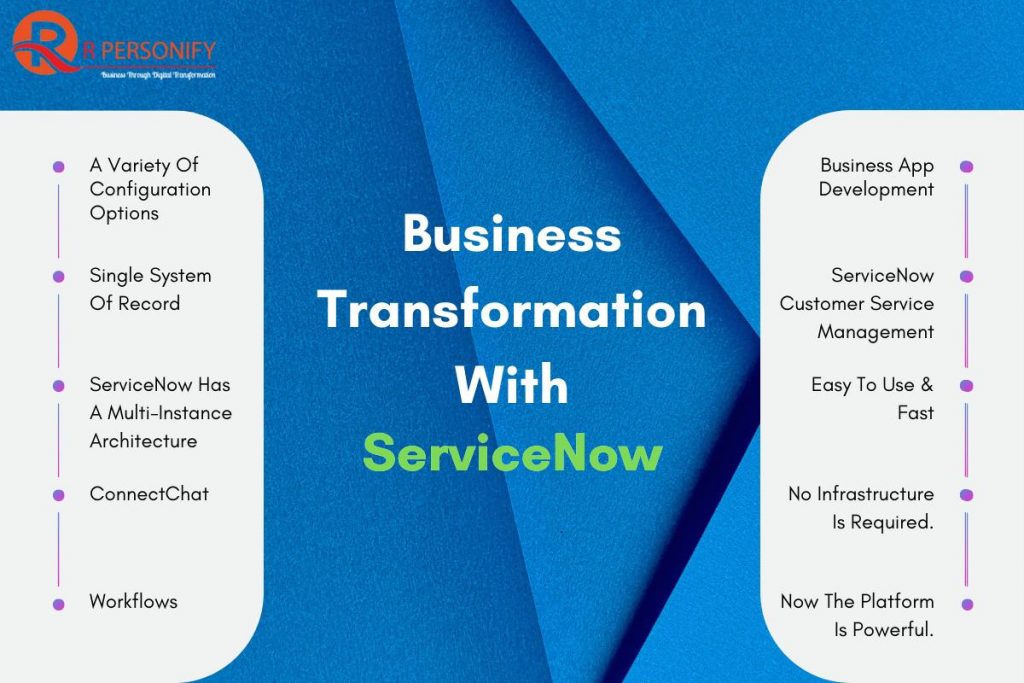
- ServiceNow –With ServiceNow, clients can opt for a packaged solution in a variety of configurations that can be tailored according to their specific needs. Unlike any other platform, it combines security and flexibility (for third-party integrations) for large enterprises.
- A single System of Record-It eliminates duplicates, thereby saving time and effort. ServiceNow will use this secret recipe to consolidate the IT and business applications, services, and other resources that are worth keeping, migrate those that need updating, and retire the rest.
- ServiceNow- It has a multi-instance architecture that makes task management easier. Using this system, each team member has their own instance, maintaining a separate resource stack.
- Connect Chat-Using a quick chat feature, technicians can access incident records and resolve the request based on incident file sharing. A drag-and-drop feature on Visual task boards also facilitates the assignment of tasks to different departments.
- Workflows –allow easy tracking of task progress and automation of daily tasks.
- Business App Development –The drag-and-drop feature eliminates the need to write any code, thereby speeding up delivery. Using cloud-based information, one can choose from reusable components, workflows, and link barriers across departments.
- ServiceNow Customer Service Management (CSM) -The use of Service Mapping reduces cases (tickets) in the long run by identifying the root cause of customer issues. Using this information, we can discover from which functional area the error originated (engineering, field services, legal, etc.).
- Easy to use & Fast-The service model defines, structures, and automates the flow of work to streamline service delivery. The configuration for ServiceNow in an enterprise is relatively simple. This is a solid platform that allows one to quickly build forms and work on rules. Furthermore, it has an open architecture that enables it to be simply plugged and played with.
- No infrastructure is required. The platform is cloud-based, so you don’t have to worry about maintaining servers. ServiceNow today offers all of these benefits to nearly any enterprise organization.
- Now the platform is powerful.
This technology is both ubiquitous and robust at the same time. ServiceNow’s robust design allows it to analyze critical metrics, provide a convenient service experience, and ensure service availability. As it is cloud-based, it is not dependent on local resources, so it can be scaled across multiple networks.
Why is Servicenow so important?
Powered by cloud technology, ServiceNow is a SaaS (Software-as-a-Service) platform that automates organizational processes and provides a consistently great user experience. It supports automatic workflows for challenges such as case management, operations management, and services management by providing an integrated development environment that allows you to build, test, and implement applications. Through self-service, users are able to identify problems and find solutions.
ServiceNow perks are far and wide. Here’s enlisting the ServiceNow benefits and features.
ServiceNow is an enterprise service management platform that extends workflow automation capabilities and can integrate with different tools and systems like CRM, ITSM, FSM, HRIS, VMware, Airwatch, etc. As well as providing greater flexibility in terms of integration, customization, functionality, and reliability. As a result of these features, the ServiceNow platform is enhanced:

- Ease of Use
ServiceNow is one of the companies that have evolved rapidly over the past decade or so and is changing how businesses operate. By automating workflows, ServiceNow enables simple streamlining and delivery of services. You don’t need to fill out those tedious physical forms or write long emails anymore. With ServiceNow, manual tasks are replaced with automated workflows that everyone can use in an organization in a hassle-free manner. As for its implementation, you don’t need to worry at all. As soon as you begin using it, you will be able to identify issues that are plaguing your workflows.
- Process Optimization
With ServiceNow for small businesses, processes are sorted and operations are scaled more efficiently. In order to accomplish this, organization activities and tasks must be taken care of. The solution gives you actionable information so you can act on it. It lets you create forms in just a few clicks. You can work on rules without worrying about the database structure with ServiceNow solutions. Due to its open architecture, this platform can be integrated into any kind of IT infrastructure.
- Faster Workflows
In order to achieve better business outcomes, ServiceNow Workflow automates multistep processes between people and systems. With end-to-end automation, your business processes will be more effective and efficient. Through the platform, organizations will be able to track tasks’ progress accurately and even automate them on a regular basis.
How can your organization benefit from ServiceNow’s Corporate Solution?
Many organizations have increased their revenue and service quality by automating business processes to maintain efficiency and streamline work. It is widely acknowledged that automation can increase productivity, lower costs, and help businesses achieve digital transformation. ServiceNow is a leader in automation, delivering a set of integrated applications that improve all aspects of workflow and production within the business. In comparison to other solutions, ServiceNow offers the same level of integration, which is essential for improving business operations. However, implementing ServiceNow is not an easy process. By partnering with ServiceNow, you can maximize your return on investment and improve your business processes.

1. Better Business Tool Integration
There are many automation tools that promise to simplify specific tasks, such as help desk tickets and invoice tracking. In addition, most solutions do not have a range of products for other business areas (HR, Security, etc.). Employees may use multiple tools that serve different functions without integrating them. This creates frustrating gaps in service, separate points of contact for software issues, and confusion among staff. Suddenly, your business solutions create more problems than they solve. The ServiceNow Automated tool suite is fully integrated and customizable. With ServiceNow, you can integrate IT Operations Management (ITOM), Performance Analytics, and HR Service Delivery (HRSD) into one integrated cloud.
2. Higher Return on Investment (ROI)
You want to maximize your return on investment by implementing business solutions. You may become hesitant to use a tool if you spend excessive time setting it up, troubleshooting errors, or waiting to hear back from a representative. To make sure your solution is as trouble-free as possible, choose automation tools that are easy to use and manage. With ServiceNow, business processes can be automated through one integrated solution. As a result, you will receive regular updates, top-notch analytics, and solutions that will not negatively impact other areas of your enterprise, which can happen when you use multiple software solutions.
3. Improve the Quality of your Service
It is important to know what works and what does not work for your business. The building of customized reports can help you quickly generate these metrics, however collecting and creating them can often be a time-consuming process. ServiceNow business automation tools enable you not only to automate data generation but also to align performance analytics with your business goals, allowing you to drive specific results. Workflow automation results in faster problem resolution, better customer service, and happier employees.
4. Increased Staff Productivity
Many people don’t realize how much time is wasted waiting for approvals, corrections, or responses. The lag time prevents your staff from getting the job done. Furthermore, if your business is centered around clients, your clients may be affected, too, if it takes too long to address their requests. By streamlining routine processes, Service Now’s workflow automation eliminates wait times and interruptions.
5. Consolidate and Improve Processes
With ServiceNow’s process automation, you can identify processes with extra steps and consolidate them, as well as increase your staff’s productivity. With their performance analytics, companies can simplify critical processes across many departments. By combining IT tools, HR resources, and managing routine problems you may even be able to eliminate processes. It will make your company run smoothly and efficiently if you remove redundant processes.
What ServiceNow has to offer in terms of Customer Experience Management
It uses AI and workflow to assign, manage, and resolve complex issues end-to-end to drive customer loyalty with connected digital workflows. Keep an eye on trends and your products and services to notify your customers when issues arise. Additionally, fix issues before your customers even realize they have them.
The ServiceNow Customer Experience Management Suite
Enhance customer experience while increasing agent efficiency by using portals, service catalogs, virtual agents, and online communities to take care of common customer requests.
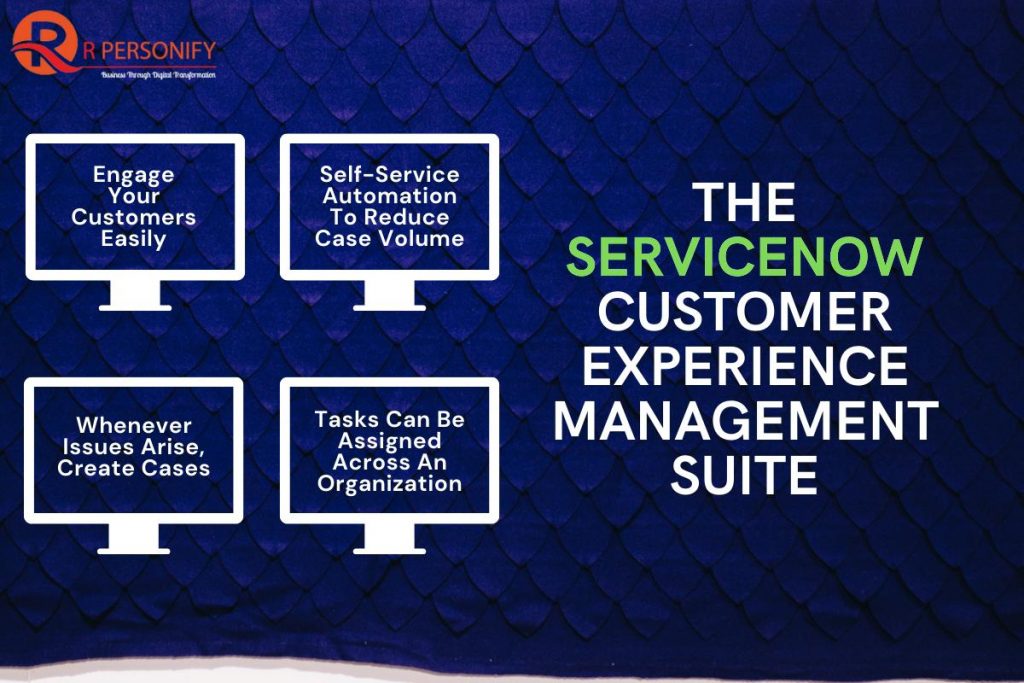
- Engage your customers easily – Ensure effortless customer service across all channels
- Automate the self-service process to reduce case volume –Make it easy for customers to help themselves by providing a self-service catalog, communities, knowledge base, and portal.
- Keep an eye out for issues and create cases as needed -Monitor customer products and services and respond to potential problems and outages
- Tasks can be assigned across an organization -Customer service should be integrated with engineering, field service, finance, and other departments.
Check out these facts of ServiceNow about your beloved service management platform that you may not have known
1) ServiceNow Store
In the ServiceNow Store, you will be able to find both paid and free applications. In order to integrate with the ServiceNow platform, integrations are developed for and deployed on it. It comes with an extensive selection of add-ons that can greatly improve the platform’s usability
2) HI Self-Service Portal
Through the HI Self-Service portal, you can submit and track requests, manage users, and ensure optimum platform performance. Using it, accounts, tasks, and instances can be managed centrally.
A fun fact, about the “HI” instance everyone uses for support, is an acronym for an earlier version of the product, called “Hosted ITIL”.
3) Discovery/Mapping/Orchestration
There are a lot of features to discover in ServiceNow. You and your company will benefit greatly from ServiceNow Discovery, ServiceNow Service Mapping, and ServiceNow Orchestration.

In today’s world, digital transformation is more important than ever. As a result, you can improve your employee experience and deliver a better customer experience. It can be problematic to use non-integrated IT tools in large numbers. As a result, information silos will be created. It can cause more harm than good. The time and money you spend on these resources will be wasted. ServiceNow is a comprehensive solution that can handle all these problems.
Let us know if you already purchased ServiceNow but didn’t receive the benefits you expected. With your assistance, we will align the employee service experience more closely with your business objectives. In order to achieve your vision, we work with you.
Contact us today.


Recent Comments