
There have been many thinkers throughout history who have used the tools and logic of their times to describe human thought processes as symbols, laying the foundation for AI concepts like general knowledge representation, such as Aristotle, Ramon Llull, and René Descartes.
AI history: where does it come from?
1956. AI was widely acknowledged to have begun this year during a summer conference at Dartmouth College. 10 luminaries in the field attended the conference sponsored by DARPA, including AI pioneers Marvin Minsky, Oliver Selfridge, and John McCarthy, who coined the term AI.

The 1950s and 1960s– A man-made intelligence equivalent to the human brain was predicted to emerge soon after Dartmouth College’s AI conference, attracting government and industry support.
In the 1970s and 1980s–Achieving artificial general intelligence proved difficult due to limitations in computer processing and memory, along with the complexity of the problem.
The 1990s through today— A renaissance in AI has been sparked by increases in computing power and an explosion of data since the late 1990s. In the past few years, artificial intelligence has led to breakthroughs in fields such as natural language processing, computer vision, robotics, deep learning, machine learning, and computer vision. Furthermore, AI is playing a more tangible role in our daily lives, as it is being used to power cars, diagnose diseases, and accentuate its role in pop culture.
What is Artificial Intelligence?

The concept of artificial intelligence refers to the simulation of human intelligence by machines, specifically by computers. AI is applied in areas such as expert systems, natural language processing, speech recognition, and machine vision.
How AI can help your business grow faster
AI is not a new concept, but its acceptance by mainstream society is a new phenomenon. Businesses can benefit from artificial intelligence in a number of ways. Most of us interact with AI on a daily basis in some way. Currently, artificial intelligence is disrupting virtually all business processes across every industry, from the mundane to the amazing. Artificial intelligence becomes increasingly important for maintaining a competitive edge as it proliferates.
Every manufacturer is looking for new ways to save money, reduce risks, and increase production efficiency. It’s crucial to their survival and sustainability. In the future, 4IR technologies, especially artificial intelligence, and machine learning, will be key.
The use of AI tools can assist companies in spotting patterns, analyzing and predicting consumer behavior, detecting anomalies in production processes in real time, and many other tasks. With these tools, manufacturers can gain end-to-end visibility across all manufacturing operations in their facilities, regardless of where they are located. AI-powered systems can also continuously learn, adapt, and improve with the help of machine learning algorithms.
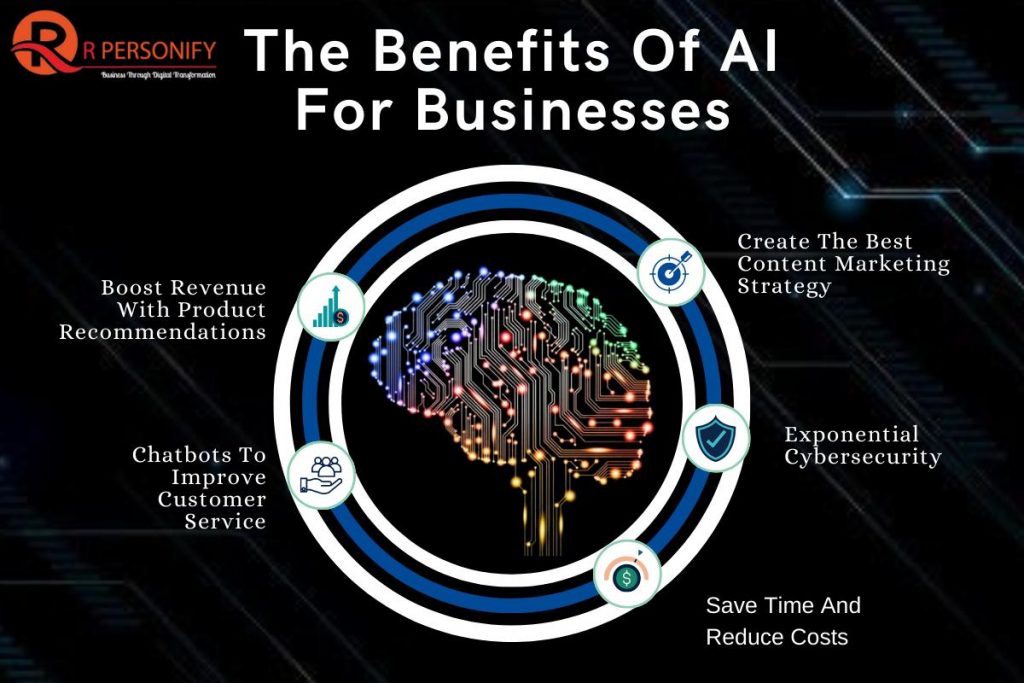
1. Make product recommendations to increase revenue
A wide range of product recommendation systems uses artificial intelligence.
Special data analysis methods are used to suggest products and information to users.
In a day, you probably see many product recommendations if you are an online shopper.
The purpose of a product recommendation is to facilitate purchase decisions by helping customers find the right products, whether on an eCommerce website, in advertisements, or in emails. Many factors can influence the recommendation, such as a customer’s purchase history or similar users’ behavior.
2. Customer service enhanced by chatbots
Chatbots imitate human conversations (or chats) with users over websites, mobile apps, phones, etc. This is a digital assistant that uses artificial intelligence.
The modern customer wants fast, easy, and personalized customer service from anywhere at any time. It is possible to provide it with chatbots.
A new marketing channel offers a truly one-on-one experience between brands and consumers.
The world of business and marketing is changing due to chatbots. They are one of the most promising trends in user interface and customer experience fields.
Their use of them is one of the most promising trends in the field of user interfaces and customer experiences.
3. Develop an effective content marketing strategy
Every second, an unimaginable number of consumers search online for products and services. They need to know about your business, and you need to position yourself accordingly.
Is that possible? Content marketing is the key to success!
In content marketing, valuable content is delivered to attract, engage, and delight customers.
Among the types of content marketing are blogs, social media updates, podcasts, videos, infographics, whitepapers, case studies, eBooks, how-to guides, webinars, and email marketing.
4. Intelligence that drives competitive advantage
AI has made competitive intelligence, research, and analysis easier than ever.
In competitive intelligence, you collect and analyze information about your competitors and industry. From products to promotions, you can track everything your competitors do. To make the best decisions, you need to know what other businesses in your industry are doing.
Artificial intelligence can help you spy on, track, and understand what your competitors are doing and why they succeed.
5. Growing your business with sales forecasting
A sales forecast is an estimate and prediction of future sales. In order to define long-term business growth, it is crucial.
With sales forecasts, you can identify potential problems in advance.
Detecting why your team is trending 28% below quota, for example, can help you figure out what’s wrong. Perhaps your competitor is offering an attractive discount. Businesses can use accurate sales forecasts to predict performance over the short- and long term.
A software algorithm that uses artificial intelligence analyzes data from CRMs, purchase histories, and past deals. Analyzing data elements such as emails, meetings, and phone calls can determine how they relate to sales.
AI software determines how each data element affects sales performance, and then it predicts what a customer will do next based on that analysis.
6. Smart Cybersecurity
The use of artificial intelligence is helping credit card companies prevent billions of dollars in fraud every year.
Financial companies are not the only ones who need cybersecurity. There are many industries that depend on it, including retail, consumer products, automotive, utilities, and telecommunications.
In the digital age, cyberattacks become exponentially more likely as businesses grow.
Businesses can be threatened by a wide range of threats, including identity theft, account takeovers, and vindictive ransomware strains.
There are many ways in which AI software can help with cybersecurity, such as vulnerability management, phishing detection, network security, behavioral analytics, and prevention control.
7. Save Time And Reduce Costs
By utilizing artificial intelligence technology, businesses can automate a variety of processes, boost employee productivity, and free up employees’ time.
With AI, you can achieve higher productivity and lower costs by automating repetitive tasks.
The use of artificial intelligence can speed up your business operations and allow you to focus your employees’ time on more important tasks.
An organization’s greatest asset is its people. The use of artificial intelligence can help them save time by automating some of their less important and time-consuming tasks.
What are the New Opportunities for Indian Industries with AI?
In the midst of the pandemic when companies are working remotely, artificial intelligence has become one of the most dominant market technologies. The government and businesses are beginning to use AI innovations to improve our lives. It is very important for consumers to be aware of how organizations are using AI in a unique way.
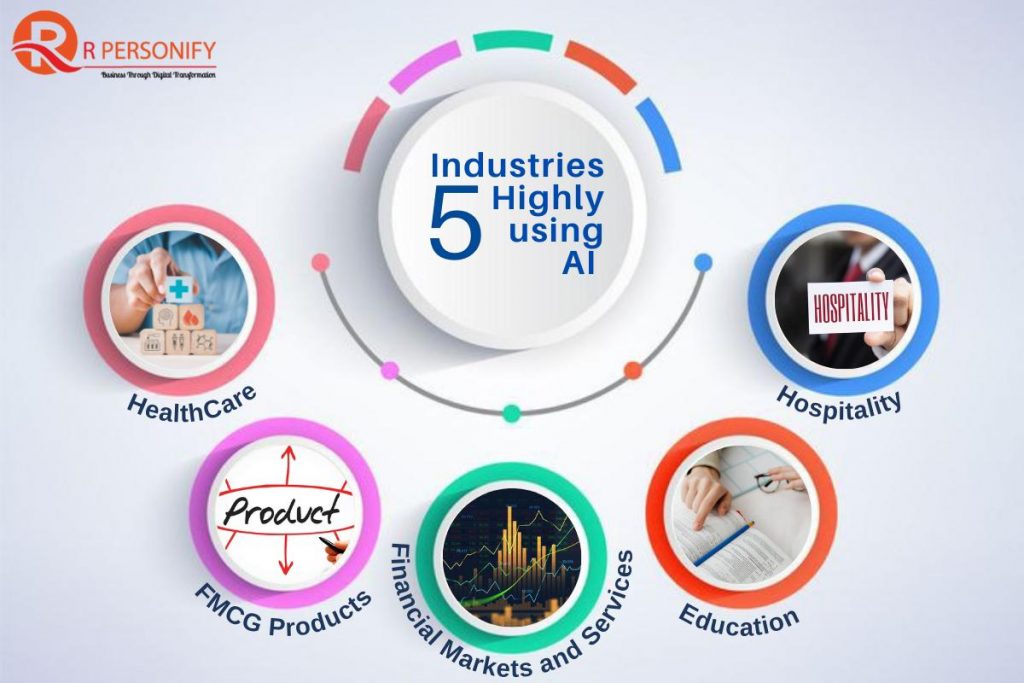
Here are five industries that use Artificial Intelligence technology innovatively.
1. Healthcare
Market growth in the artificial industry has been dramatic, particularly in the healthcare sector. Internet of Things and Artificial Intelligence solutions are being developed by Indian IT companies such as Thalamus Irwine to assist state and federal governments. The purpose of this test is to identify weak communities that may need vaccination. In order to improve healthcare, Co-Win is a cloud-based solution that allows users to assess, monitor, and arrange vaccines.
2. Products
A Chatbot powered by artificial intelligence (AI) was launched by the National Payment Corporation of India (NPCI) to offer real-time information on services like FASTag, APIs, and RuPay. It converts physical samples into digital images and can review the visual data automatically to provide valuable insights.
3. Financial Markets and Services
The market is experiencing a technological revolution due to artificial intelligence (AI), and intelligence automation is at its peak. In the financial sector, a detailed plan with AI strategies is helping with the best initiatives to grow. While analyzing consumer spending habits, Machine Learning can build advanced credit models.
4. Education
Atal Mission Innovation was launched in 2016 by Niti Ayog to assist entrepreneurs in incorporating AI into their businesses. In the wake of the pandemic, EdTech companies are now offering the latest technologies to educate students about AI and create projects.
5. Hospitality
The use of artificial intelligence in hospitality management is increasingly important because it can perform traditionally human functions 24/7. As a result, hotel owners may be able to save a significant amount of money, eliminate human error, and offer more personalized services.
The travel industry places a great deal of emphasis on customer service, with hotels often living or dying by how they treat their customers. This aspect can be improved almost endlessly with artificial intelligence, from greater personalization to tailored recommendations.
Artificial Intelligence in CyberSecurity

A huge amount of capital has been poured into cybersecurity companies in recent years by venture capitalists. These developments are a result of the fast pace of development in the cyber risk landscape without any sign of slowing down. Since online hackers control devices to propagate their wrong intentions, cybersecurity is at the top of every CISO’s and CEO’s priority list today.
In the future, AI will become even more efficient, since it has already arrived. When it comes to artificial intelligence or AI, unless India is at the forefront of this development, the future does not look good for us. It is already too late to take advantage of the Industrial Revolution, the semiconductor race, operating system dominance, or the mobile revolution. In the next few years, three new revolutions will take place: quantum computers, autonomous electric vehicles, and artificial intelligence. There are already ties between AI and the other two fields. Although we promise to be a future superpower, we lag far behind in all of these areas.
Future of AI in India

There is a bright and promising future for Artificial Intelligence in India. It is estimated that AI can add $957 billion – or 15% of the Indian economy’s present gross value – by 2035. There are many sectors in which artificial intelligence can add value, including energy, retail, manufacturing, healthcare, education, and agriculture. Additionally, AI experts and others will be able to find jobs in all of these sectors.
The Indian IT industry and tech startups must update their technologies and increase their AI capabilities at an enterprise level. Achieving technology adoption requires the right skills. Artificial intelligence in India was created by NITI Aayog in June 2018. In the report, the government outlined its plans to build the sector in the country and the roadmap for the future. By implementing AI appropriately, the nation will be able to develop economically while contributing to public growth to a large extent.
According to the report, startups grew by 108% in financial India in 2018. AI was also one of the domains that saw the fastest adoption across different fields. A total of 400 startups are working in the fields of artificial intelligence and machine learning at the moment. There has been an increase in investments by private players in India’s AI industry since 2016.
The terminology of investment in India has made progress, but it still lags far behind countries like the US and China. Since India has an abundance of STEM skills and a growing younger generation, it is likely to use AI to enhance its economic growth and quality of life.
In cities such as Bengaluru, New Delhi, Hyderabad, and Mumbai, there are many startups that work on artificial intelligence concepts. They offer a wide range of products, ranging from multilingual chatbots to online shopping assistance and automated customer data analysis. Among the industries, they are involved in are e-commerce, ed-tech, healthcare, and fintech. These companies have been showing promising results even though they are still at the nascent stage.
Conclusion
Global tech giants and leading companies are not the only ones to benefit from artificial intelligence. AI can help your business grow and stay competitive by allowing you to make better decisions more quickly. Artificial intelligence can change the way you manage your business.
AI will transform the business landscape and redefine how companies compete. Business leaders who are forward-looking will be able to take advantage of this massive opportunity.



Recent Comments