
All Boons Of Oracle ERP Cloud You Must know!!
A Brief History Of ERP
A transition from paper cards to mobile devices
More than 100 years have passed since ERP was created. A paper-based manufacturing system called economic order quantity (EOQ) was developed in 1913 by engineer Ford Whitman Harris. EOQ was the industry standard for decades. When the toolmaker Black and Decker became the first company to integrate EOQ concepts with a mainframe computer in 1964, it changed the game.

Manufacturing resource planning (called MRP II) replaced MRP as the standard in manufacturing. The core manufacturing components of MRP II were modules: purchasing, bills of materials, scheduling, and contract management. First-time integration of different manufacturing tasks has been accomplished. MRP II offered organizations other compelling examples of how organizations could optimize operations and boost operational efficiency through better production planning, reduced inventory, and reduced waste (scrap). In the 1970s and 1980s, MRP II incorporated finance, customer relationship management, and human resources data as an extension of manufacturing. Business management software had a name by 1990—enterprise resource planning. In this article, we will explore the benefits of Oracle’s ERP Cloud.
Cloud and on-premises ERP deployment models
ERP adoption grew rapidly during the 1990s and the beginning of the 21st century. In parallel, ERP system implementation costs began to rise. For the software to run, big machines were usually found in a server room, typically on company premises. Both hardware and software licenses require capital investments that depreciate over a five to ten-year period. Furthermore, organizations often want to customize their ERP systems to fit their specific needs, resulting in additional expenditures such as software consultants and training.
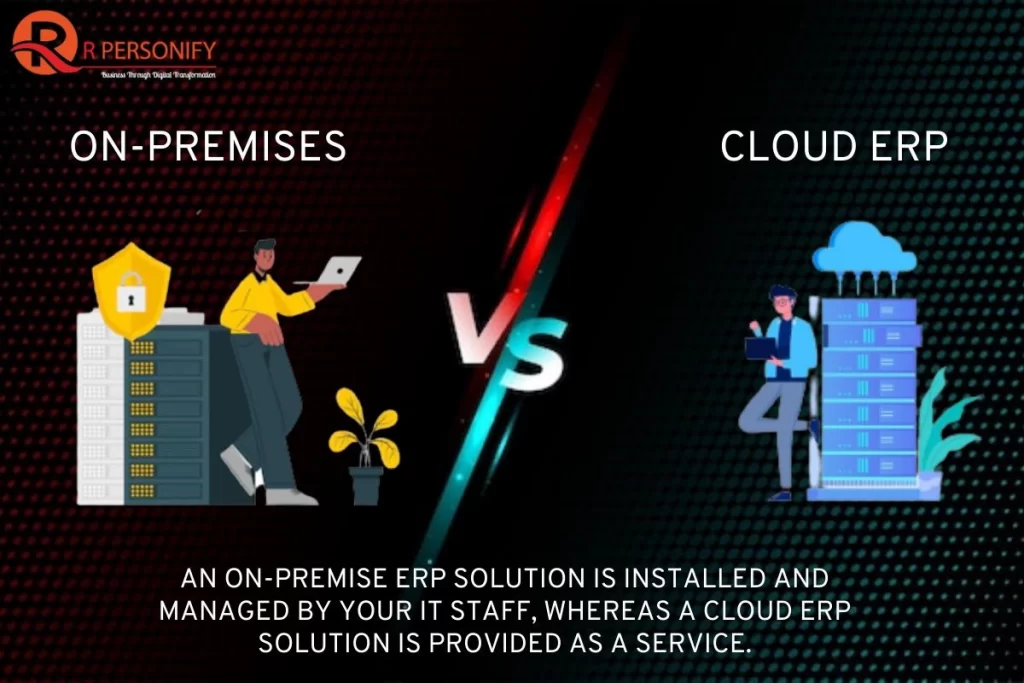
At the same time, ERP technology was evolving to include new features, such as embedded analytics. Over time, organizations found that their on-premises ERP systems were unable to cope with modern security demands or emerging technologies such as smartphones.
Implementing ERP in the cloud: A new delivery model
Introducing cloud-based ERP, specifically software-as-a-service (SaaS)… A company’s ERP software runs on a remote server network instead of inside its own server room when it’s delivered as a cloud service. Cloud providers manage, patch, and update software several times a year, not every 5 to 10 years as they do with on-premise systems. Since the cloud eliminates the need for companies to purchase software and hardware, or hire additional IT staff, it can reduce both operational and capital expenses. As a result, the organization can invest its resources in new business opportunities, and its ERP software is up-to-date at all times. Instead of managing IT, employees can focus on more value-added tasks such as innovation and growth. The benefits of Oracle ERP Cloud can help organizations increase productivity and make better decisions.
Based on Oracle Fusion Applications, Oracle Cloud ERP offers a cloud-based ERP service that implements Oracle Fusion Architecture and Oracle Fusion Middleware. A suite of Oracle Cloud ERP applications was announced by Larry Ellison, Oracle’s CEO and CTO, in June 2012 as part of Oracle Cloud, the company’s cloud-based applications suite. Oracle Cloud ERP was announced as a preview at Oracle OpenWorld 2012. The company reported 1,300 Oracle ERP Cloud customers in October 2015. It released Release 13 on August 2, 2017.
Introduction to Oracle ERP Solutions
Tomorrow’s leaders are those most capable of adapting to change today. Oracle Fusion Cloud ERP is a complete, modern, cloud ERP suite that provides your teams with advanced capabilities, such as AI to automate the manual processes that slow them down, analytics to react to market shifts in real-time, and automatic updates to stay current and gain a competitive advantage.
Why Should You Consider Oracle’s ERP Cloud Solutions for Your Business?
In today’s business world, ERP is unavoidable. By integrating enterprise data and processes into ERP systems, businesses can align departments and streamline workflows, resulting in huge savings. Here are a few examples:

- A better understanding of the business- based on real-time information
- Reduced operating costs- based on streamlined business processes
- Improved collaboration- Data shared by users in contracts, requisitions, and purchase orders
- Enhanced efficiency – Business functions and processes are well-defined to provide a unified user experience
- Consistently designed infrastructure- Business activities are conducted the same way from back to front
- Improved adoption by users -because of a similar user experience
- lowered risk –through improved data integrity and financial controls
- improved management and operational efficiency –through uniform and integrated systems
Benefits for various types of companies
Despite the fact that ERP starts with “enterprise,” it is not just a tool for large firms. All sizes of companies can use it and you can add workers, machinery, departments, and locations as you grow.
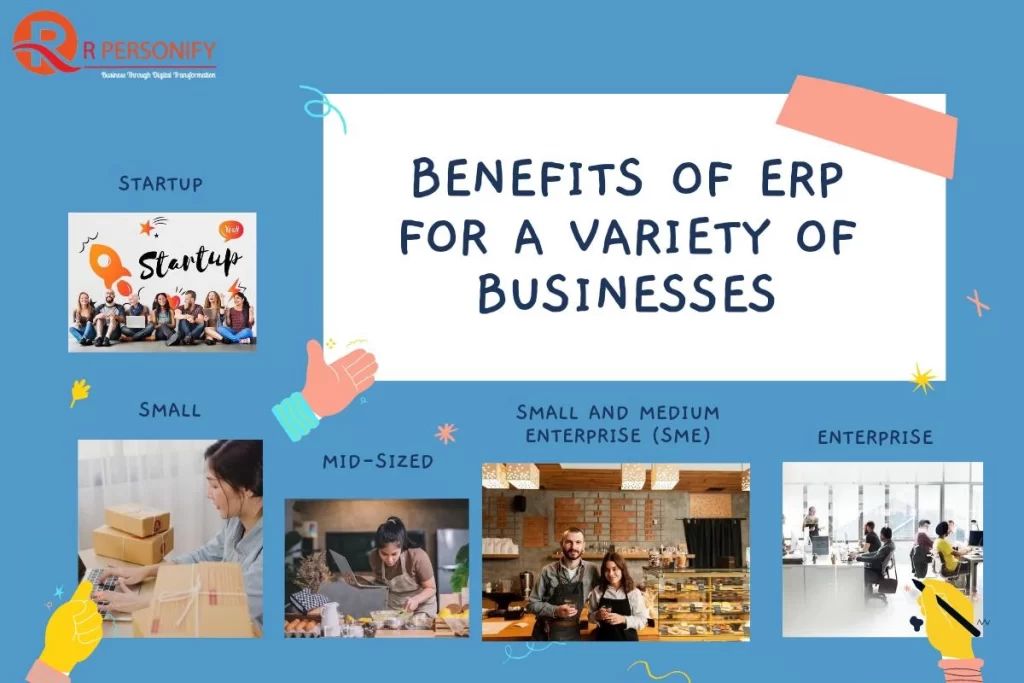
Startup
Typically, startups have five to ten employees or freelancers. Small businesses and home offices tend to have small facilities, with Excel or similar tools to manage business affairs and bookkeeping.
Small
Most of these businesses are mom-and-pop corner shops, which usually specialize in a certain type or amount of product (i.e., pharmacies, fishing stores, convenience stores, etc.). Keeping track of finances and doing other business affairs is possible with small business accounting systems.
Mid-Sized
Think of a mid-sized company as an organization with roughly 50 to 100 employees. ERPs centralize workers, departments, tools, and more while growing if you’re looking to expand.
Small and Medium Enterprise (SME)
There is no one-size-fits-all approach when it comes to SMEs. There is actually a classification of SMEs based on their sizes and industry type. These businesses require accounting and other business solutions.
Enterprise
These companies employ between 1,000 and 10,000 people and have local, national, or global locations and partners. Examples are Walmart, Apple, and Microsoft.
What are Oracle’s Key Features?
Cloud-based software like Oracle Cloud has a wide range of benefits. Due to its name, ERP Cloud is designed to live in the cloud. It is known for its flexibility. But what are some other benefits?

- Upgrades are not necessary
Cloud-based software automatically receives updates and new functionality. It only requires an internet connection. As a result, you avoid the potential expense of system upgrades in the future, so your system is always up to date.
- LESS EXPENSIVE UP FRONT
If you opt for on-premise ERP software, you will need to invest in the equipment and personnel needed to operate the system. A subscription-based ERP Cloud is run over the internet, which reduces the initial implementation costs.
- SCALEABLE
The ERP Cloud’s ability to grow with your business is one of its most prominent features. In order to drive digital transformation and profitability, any business can leverage ERP Cloud for automating processes, such as inventory management, or for reducing costs through streamlining and a lower total cost of ownership.
- CURRENT SECURITY MODELS
Many companies opt for cloud-based ERP platforms to secure their data. In addition, ERP Cloud keeps your system up-to-date with the latest security measures with its automatic deployment of updates. Further, cloud data storage offers an economic benefit as well – it can be outsourced to a larger and more secure third party, eliminating hardware maintenance costs.
- MODERN USER EXPERIENCE
The use of ERP for business purposes is now widely accepted, but it was not always so. Despite the improvements in acceptance, businesses are still on the road to digital transformation. ERP Cloud has mobility features that keep workers connected throughout the day
The ability to make informed decisions and personalize the customer and employee experiences is enabled by real-time analytics that are connected but agile.
- THIRD-PARTY INTEGRATION
Despite ERP Cloud’s comprehensive software suite, your business may require more to maximize the benefits of your ERP system. Third-party solutions can be integrated with your system.
- BETTER BUSINESS PROCESSES
Oracle ERP Cloud is an industry leader, named as one of the most powerful ERP solutions. As ERP Cloud simplifies IT systems and enables the addition of security and new features faster, business leaders are more and more relying on it.
Oracle’s Approach to Enterprise Resource Planning on the Cloud
In addition to the AI features, Oracle Fusion Cloud ERP offers analytics to make real-time adjustments to market shifts, and automatic updates to stay current and gain a competitive advantage.
A cloud-based ERP solution from Oracle is the ERP of tomorrow, today. A cloud-based ERP solution from Oracle is the ERP of tomorrow, today. This modern user interface is easy to use and provides state-of-the-art data security. With rapid growth, the company has become a market leader, particularly among growing companies in professional services, financial services, healthcare, and higher education.
Oracle ERP Cloud typically has lower initial and ongoing costs than comparable on-premise solutions, while delivering capabilities and functionality that benefit businesses. Through streamlined and automated processes, Oracle ERP Cloud helped customers transform their businesses through greater visibility over the organization. Compared to on-premise systems, Oracle ERP Cloud requires less hardware, and IT management personnel enables faster deployments, and smoother upgrades, and requires less maintenance.
ERP System Examples
These ERP systems can help you automate your company’s processes.
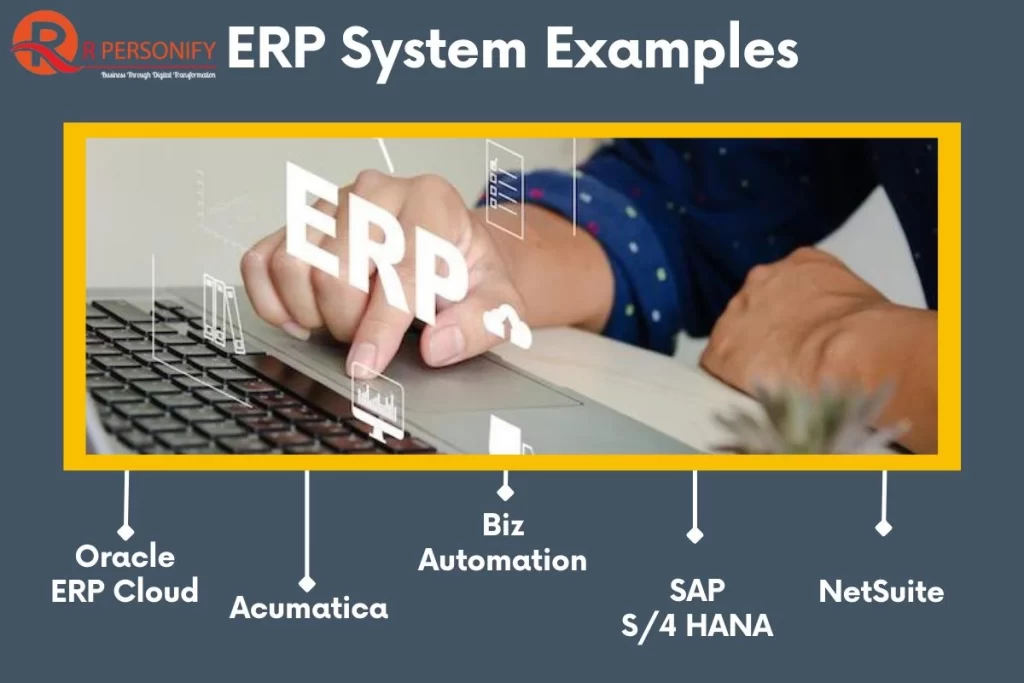
- Oracle ERP Cloud
- Acumatica
- BizAutomation
- SAP S/4 HANA
- NetSuite
Latest Announcement from Oracle- The First A.I. Enabled ERP Cloud Solution!
The Oracle Cloud ERP and EPM applications now include artificial intelligence capabilities. Machine learning-based innovations include automatic expense reporting, a virtual assistant for project management, advanced financial controls, and supply chain management driven by projects.
“Oracle continues to deliver on the finance innovation promise expected by our customers,” said Rondy Ng, senior vice president, of Oracle Applications Development. “Our pervasive AI strategy delivered via continuous product updates ensures rapid adoption with immediate business results. This allows finance and operations teams to stay ahead of the technology curve and retain a competitive advantage.”
The Oracle ERP Cloud has been selected by more than 6,000 organizations in 112 countries and 23 industries for its complete, innovative, and secure features. Embrace new technologies like artificial intelligence, digital assistants, natural language processing, blockchains, and the Internet of Things with Oracle ERP Cloud to boost productivity, reduce costs, and improve control for organizations of all sizes.
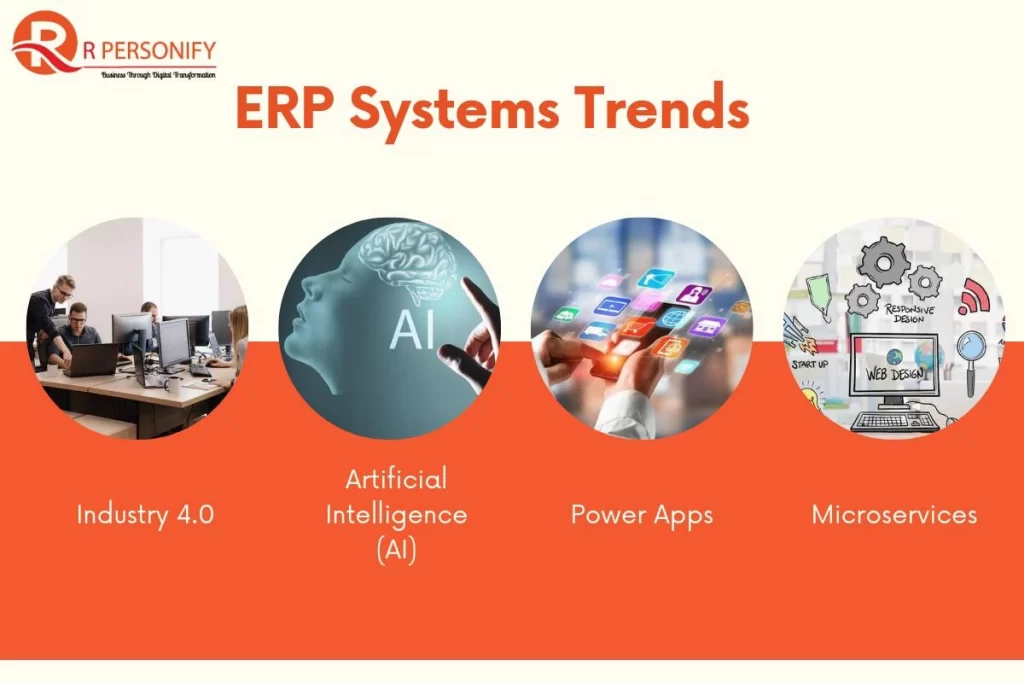
Enterprise Resource Planning (ERP) Systems Trends
A company’s ERP software system is often one of the major investments it will make. Before deciding which solution to implement, research existing options and future ERP trends.
- Industry 4.0
Intelligent technologies such as the internet of things (IoT), virtual reality, and augmented reality can be used to achieve digital transformation in manufacturing. In addition to ERP not managing these technologies, the ERP system must exchange data with both hardware (sensors and fixed assets) and software (IoT management and digital twins).
- Artificial intelligence (AI)
AI has multiple applications that can improve ERP efficiency. AI analyzes large amounts of complex data, identifies trends, and makes recommendations to improve business processes. Automating processing with robotics (RPA) allows users to create bots that can perform basic tasks rapidly and efficiently. Several ERP vendors use conversational user interfaces, in which users can ask questions or instruct computers to perform simple tasks such as sending emails or printing invoices by sending a message.
- Power Apps
Power Apps is a suite of mobile apps, data services, and platforms that enables rapid app development for your business. Today, PowerApps are a big trend in organizations. Most people are using or looking for a power app. They can be incredibly useful to organizations. Using them improves efficiency, and communication, and keeps an organization up-to-date with the latest trends. Companies can use apps to perform their daily tasks in a way that is more user-friendly and efficient. Additionally, PowerApps can help an organization gain more exposure.
- Microservices
In order to provide more flexible solutions, vendors have been increasingly using this kind of software architecture. With microservices, buyers can combine software modules from several different products, rather than using monolithic ERP. In addition, manufacturers who handle their distribution and sell online will benefit from custom solutions that include features normally sold separately.
Why ERP Cloud is the Future of Business Technology?
When you think about the future of your business, the ERP system must also always be innovative. Analytics provide insights into your operations, but real-time information gives you a clear picture of them. Collaboration is facilitated by information sharing and connectivity, making it easier for employees and departments to understand business data.
Meanwhile, enterprise technology is evolving to meet our needs as technology improves our lives. Here are some ways ERP Cloud is embracing new capabilities:
- Cloud operation
The main advantage of ERP Cloud is that it is designed and deployed in the cloud. We’ve seen that cloud-based solutions have numerous advantages, including lower upfront costs, data security, and more. Enterprise cloud software is chosen for their business by eight out of ten CFOs.
- Designed to support next-gen technology
ERP Cloud can not only scale with you, it can also adapt to changes in the business. A number of new tools are being hailed as the future of business, including machine learning, artificial intelligence (AI), and the Internet of Things (IoT). ERP is ideal for automating these processes.
- Modern platform and design
A key factor in the effectiveness of ERP is the user experience. In other words, if a platform is easier to use and understand, then employees are more likely to effectively use it. Users of ERP Cloud can utilize personalized and automated features, such as Oracle Orchestration Cloud notifications, to free up their time and focus on more critical tasks.
- Mobile
Mobile technology is no exception to the prevalence of ERP. The ability to access your business data anywhere has become a necessity for businesses. Real-time analytics and operations are also integral for businesses. Mobile-based capabilities are easy to implement and have become commonplace.
Conclusion
Using next-generation, cloud-based, and modern ERP solutions enables organizations to respond quickly to volatile markets and industry trends while reducing the cost of support.
Providing businesses with a powerful and flexible cloud software solution, Oracle ERP Cloud is part of the growing trend of cloud computing. Learn more about Oracle ERP Cloud applications at Top 5 features to optimize your business processes with the Oracle Business Suite blog. Contact us to find out how your business can take advantage of the future of the enterprise cloud.





Recent Comments