
The digitization of the industry will create new business models and present considerable opportunities for small and medium-sized businesses. It is now imperative for every manufacturing organization to go through a radical change utilizing digitalization in order to meet customer demands, meet corporate objectives, and remain competitive worldwide.
India’s digital transformation market is expected to reach $710.0-billion by 2024. Accordingly, it represents a 74% CAGR. According to this figure, the services and technology industry in the country is progressing rapidly. India began advancing toward achieving its digital transformation goals faster after the outbreak of the Covid-19 pandemic. As a result of a series of subsequent lockdowns, the country’s digital infrastructure has improved.
AI and digital technology have been embraced by many technologies and business leaders. In the coming years, this trend is likely to gain traction.
Introduction: What is Digital Transformation?

The digital transformation of an organization involves the implementation of computer-based technologies in its products, processes, and strategies. As a result of digital transformation, organizations are better able to engage and serve their workforce and customers.
What are the Benefits of Digital Transformation for Businesses and Organizations?
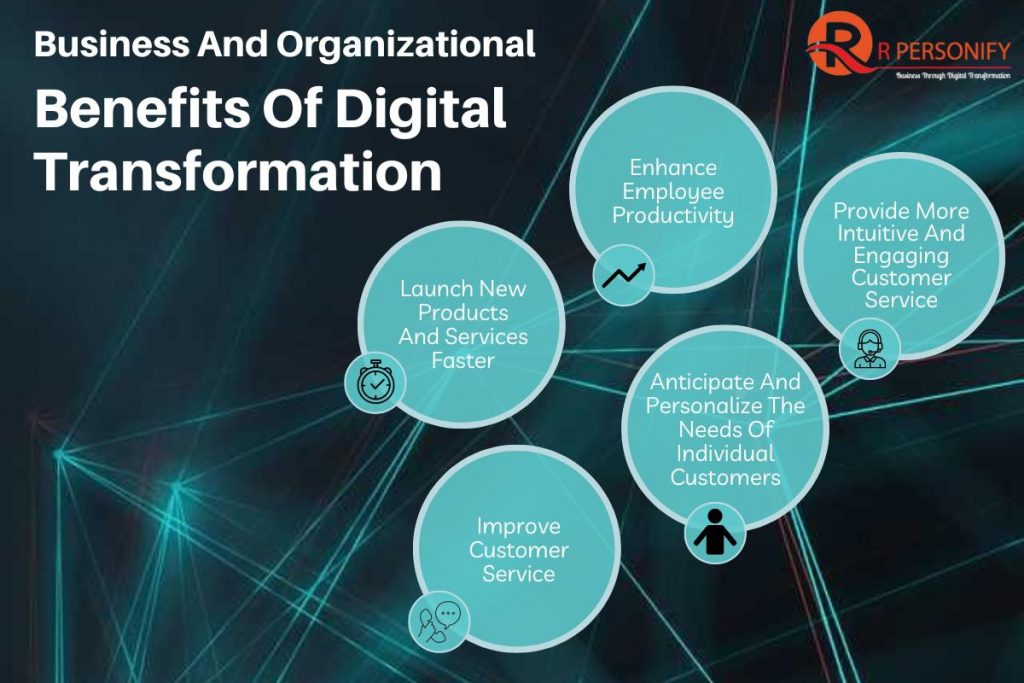
A company’s key stakeholders – employees, customers, partners, and shareholders – can be better served with the help of digital transformation.
By integrating computer-based digital technologies in business operations, organizations are able to:
- Speed up the launch of new products and services
- Enhance employee productivity
- Improve customer service
- Understand individual customers better in order to anticipate and personalize their needs
- Provide more intuitive and engaging customer service.
Digital transformation technologies: what are they?
Digital transformation and digitization of an organization are driven by technology. There is no one application or technology that enables digital transformation, but several technologies are crucial to digital transformation:
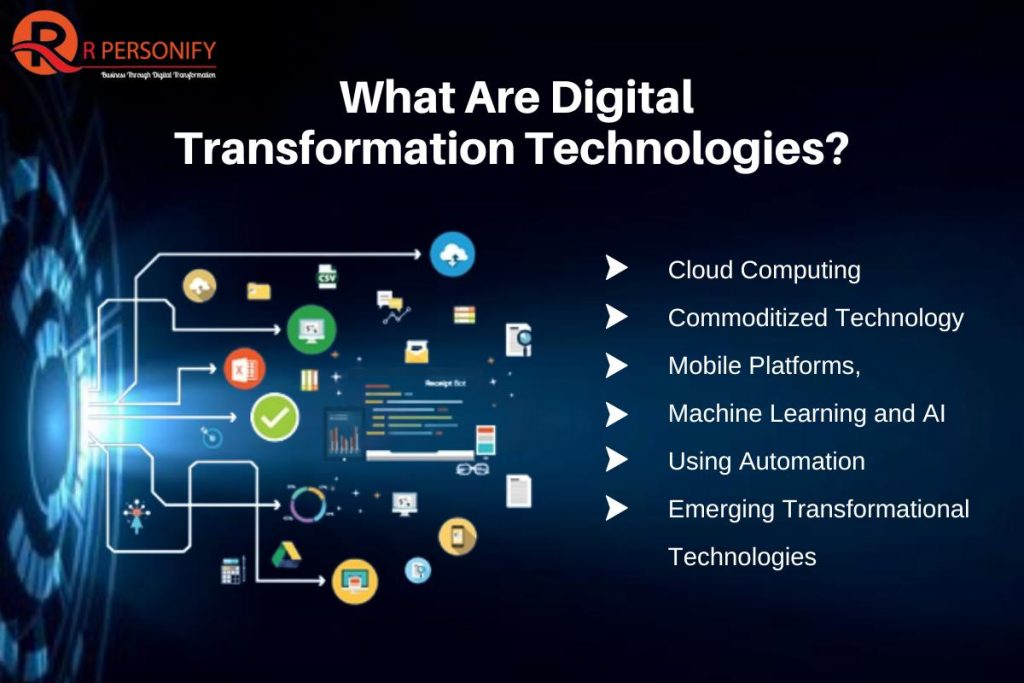
- Cloud computing, allows organizations to access their software, new features, updates, and storage from anywhere at any time
- Commoditized information technology, enabling an organization to invest resources in IT customizations that differentiate it in the marketplace
- Mobile platforms, allow people to work wherever they are and whenever they want
- Machine learning and AI, combined with comprehensive data programs, help organizations make faster, more accurate decisions in sales, marketing, product development, and other strategic areas
- Using automation, such as RPA, human tasks can be handled more quickly and efficiently by bots, freeing up human resources for more valuable activities, and
- Additional emerging transformational technologies that can help companies move faster, work more efficiently, and create new products and services include the following:
- blockchain
- augmented reality (AR) and virtual reality (VR)
- social media
- IoT
- edge computing
How Can AI Help with Digital Transformation?
Artificial intelligence (AI) is a major component of digital transformation, which includes machine learning (ML), deep learning, natural language processing (NLP), and predictive analytics. These technologies make enterprise systems smart enough for analyzing data, predicting the future, automating routine tasks, and reminding us about important things.
A decision about whether to use artificial intelligence (AI) or not becomes less relevant for organizations as this century unfolds.IDC reports that 50% of businesses have adopted AI in some business functions, and 75% plan to digitally transform their operations by 2025.
Using AI to transform business operations in five specific ways:
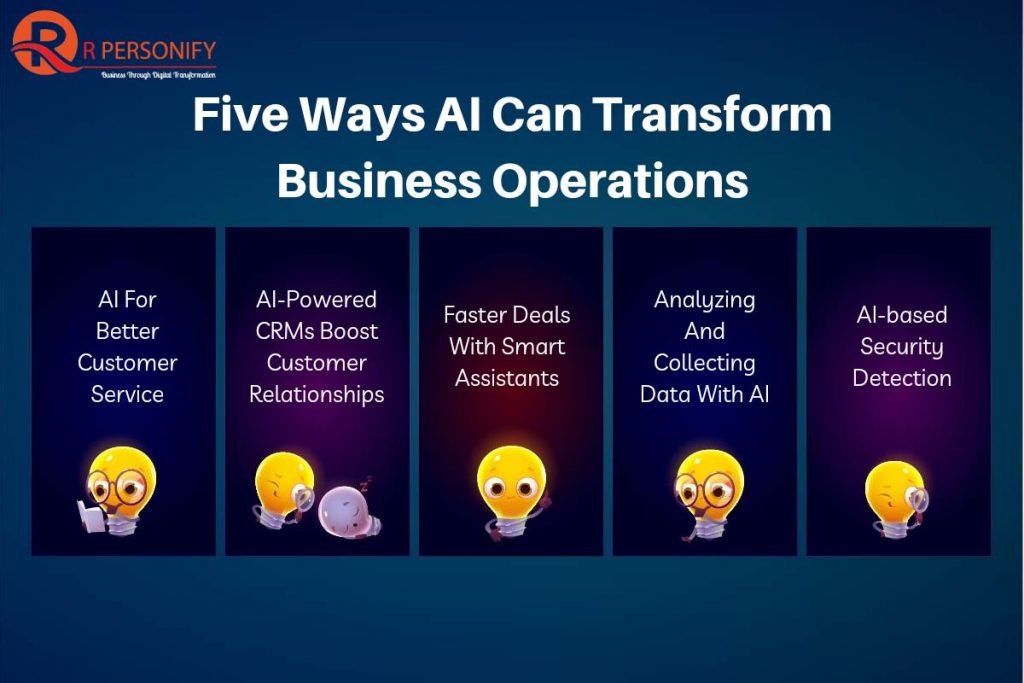
1. Artificial Intelligence for Better Customer Service
Artificial intelligence starts with simple chatbots and progresses to sophisticated virtual customer service agents.
- Using a FAQ bot, you can answer your visitors’ most common questions. The ML-driven bot responds to keywords entered by users.
- Alexa, Siri, and Google Assistant are virtual assistants that answer more complex questions and assist with tasks and orders.
Intelligent virtual assistants, such as Microsoft Power Virtual Agents, can recognize the context (such as issue type and customer type) and handle incoming requests accordingly.
2. AI-powered CRMs boost customer relationships
AI helps sales teams understand the needs of customers based on their web searches, order history, and product reviews, enhancing customer engagement and automating routine CRM functions.
There are several CRM software solutions that are popular, including Zoho, Salesforce, Sugar CRM, and Siebel. Customer input is processed using AI to create smart recommendations for your brand.
3. Faster deals with smart assistants
Using smart sales assistant software, such as Google’s Nespresso Assistant, retailers are able to predict shoppers’ needs in advance
- Buyers are able to identify what they need or want when smart assistants ask targeted questions.
- Artificial intelligence-powered systems are capable of identifying and presenting suitable products to buyers based on algorithms.
- A smart system assists buyers in closing sales.
Due to its low-touch nature, AI-guided sales is the fastest-growing sales trend on the market today and is predicted to be acquired by 60% of sophisticated companies by 2025.
4. Analyzing and collecting data with AI
If you could predict what you should avoid and automate behaviors that lead to more profitable outcomes, what would your company be like in the future?
With AI-trained software such as SAS Advanced Analytics, your business can identify which products and marketing strategies are most likely to attract customers and fill any gaps.
The following are some features of smart software:
- It is possible to detect unsuccessful marketing by using anomaly detection. Determine and remove features that repel prospective customers.
- Social media sentiment analysis can help you gauge how people feel about your brand and how to improve it.
- Predictive analytics for fraud detection and projections of turnover, attrition, and retention.
5. AI-based security detection
Businesses use artificial intelligence to protect their intellectual property and improve their physical security. Here are some examples:
- Screening by security agencies, such as police, to identify suspicious individuals. AVATAR uses artificial intelligence to screen body movements and facial expressions.
- Providing security and preventing crime. Machine learning algorithms are used by AI-driven crime tools, like Armorway, to anticipate terrorist threats.
- A system for protecting endpoints. A number of vendors have developed AI software for identifying and preventing malicious endpoints and preventing data breaches, including Skycure, Lookout, and Wandera.
What are the Benefits of Digital Transformation for Industries in India?
Several businesses have already converted to new business models or invested in new technologies to take advantage of the digital revolution.
Organizations cannot avoid digital transformation in our current digital world.
Digitization has many advantages for businesses including improving efficiency, reducing expenses, and boosting production.
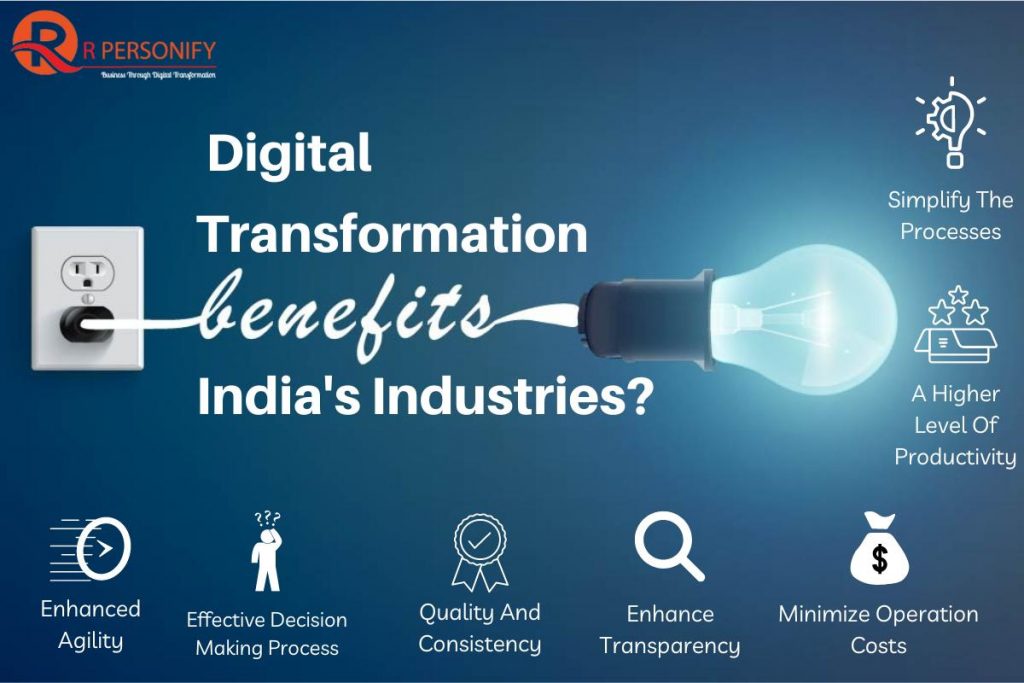
1- Simplify the processes
It is imperative for businesses to continuously search for innovative ways to improve their efficiency. Digitalization is the key to becoming more efficient in your business.
An automated business process delivers reliable results every time. In order to achieve greater transparency and fairness in your company, you should automate processes and related business rules.
To be efficient, you must utilize time, effort, and money effectively when completing a task or achieving a goal. Digitalization reduces the time, effort, and cost of completing a task, which is one of the most significant advantages of the process.
2- A higher level of productivity
Your employees will be freed from monotonous jobs when you automate manual repetitive tasks, allowing them to focus on more innovative, difficult initiatives that will improve your business’ efficiency.
By automating business processes, tasks can be completed faster and more accurately. In addition, process automation allows employees to make better use of their time at work.
3- Minimize operation costs
Business owners want to save time and, more importantly, money. As manual tasks and processes are conducted one at a time, they are intrinsically slower than automated ones.
It is estimated that inefficient processes cost organizations up to 30% of their revenue each year. Manually performed business procedures increase the chances of wasting resources significantly.
By leveraging digitalization, you can make the most of your core resources in an efficient and cost-effective manner.
4- Enhance transparency
In order to obtain the information you need, critical metrics (financial, billing, collections, sales, and/or support) can be gathered and reported for each process you’ve automated.
Long-term success depends on a transparent industrial process. A digitally monitored process will increase the level of trust in how things are done at higher levels.
An organization’s visibility increases when its processes are well documented and its workflow is transparent. Because everyone understands what they’re supposed to be doing at all times, managers don’t have to worry about employees forgetting what they’re supposed to do. The ability to visualize processes makes it possible for leaders to identify bottlenecks and opportunities immediately.
5-Quality and Consistency
The main benefit of digitalization is that it ensures that every operation is conducted consistently, resulting in high-quality, reliable results.
Automating your customer service follow-up process, for example, will ensure that your company provides the same level of support to all of your consumers. With the assurance of consistency and quality, as well as the savings in time and cost, you may be able to design higher-quality products with more features while reducing manufacturing time and cost.
6- A greater ability to move quickly
Today, businesses need to keep up with the fast-paced digital environment. The company must be able to respond rapidly to any shifts in the market, upheavals, or new opportunities.
When business processes are automated, organizations can modify and adapt to changes at a relatively fast rate, which allows them to be agile enough to shift directions rapidly.
7- A more effective decision-making process
A digital world and an information-rich management system work hand in hand; information is analyzed and transformed into knowledge, and knowledge leads to better decisions.
The Future of Digital Transformation in India
As part of its Digital India initiative, the Ministry of Human Resources has been working on Atma Nirbhar Bharat and Aadhar as well. In India, the initiative aims to promote digital transformation and reap its benefits.
Indian companies focus on AI (artificial intelligence) and data analytics to maximize their growth in the digital space. The importance of these technologies lies in the fact that they will shape and drive fintech companies’ growth engines.
According to the current situation, India has a bright future in digital transformation. Let’s take a look at what the future holds for India.
5G Now that it’s just around the corner, India is getting ready for it. The next phase of India’s digital transformation will be powered by the ultrahigh speeds and lower latencies of 5G networks
There will be significant growth in several sectors as a result of high-speed internet and its penetration of the Internet, including governance, energy, healthcare, and education. Additionally, it will facilitate the emergence of new markets and digital ecosystems by reducing India’s digital divide.
As a result of the development of new markets and digital ecosystems, India’s low-income segment will gain new opportunities and services. Due to the millions of new jobs created, it will offer new and exciting opportunities for employment. Governments can use technologies such as artificial intelligence, the Internet of things (IoT), cloud computing, blockchains, and robotics to further enhance India’s digital economy.
Why You Should Care About Digital Transformation
People are more prone to error than machines when it comes to performing tasks. Machines never tire and can run continuously 24 hours a day. We must assign tasks to computers that we do not wish to perform and focus on more challenging tasks. Digital transformation represents one of the most important trends of the present. In the future, the technology will gain traction as businesses adopt it more readily. India’s digital transformation is set to reach new heights as it improves its digital infrastructure and has a growing number of internet users.
Final Thoughts
In order to meet the demands of the digital age, we must move forward and get ready. There is no way to avoid it, as there are no alternatives. For a nation like India, the cost issue presents the greatest obstacle. As a result, we are still a long way from achieving our goals. Rather than a transition, this is a revolution. As everything becomes global, our primary competitor will also keep pace. Technology investments must be made in line with a company’s business goals and the desired return on investment (RoI).


Recent Comments