

Greetings Everybody! This article is about digital transformation and why it is important for small and medium-sized businesses.
What Is Digital Transformation?
A business process can be transformed digitally to make it more efficient or effective by using digital technologies. In other words, technology is not simply used to replicate existing services digitally, but to transform them into something much better.
The definition of digital transformation varies by industry and project. A major component of the transformation will probably involve rethinking business models, changing the underlying technology stack, and transforming the customer experience.
How Digital Transformation Can Help You Grow Your Small /Medium Business
For every company, digital transformation means something different. Some people upgrade to the latest ERP software, while others automate their marketing funnels.
Our definition of digital transformation can be broadly defined as integrating digital technology into various aspects of a business. In addition, it examines how an organization operates and provides value to customers.
What is an Ideal Digital Transformation Framework for your small and medium business?
Depending on the organization’s specific needs and challenges, digital transformation strategies will always differ.
In order to achieve digital transformation success, business and technology leaders should note a few constants from successful case studies.
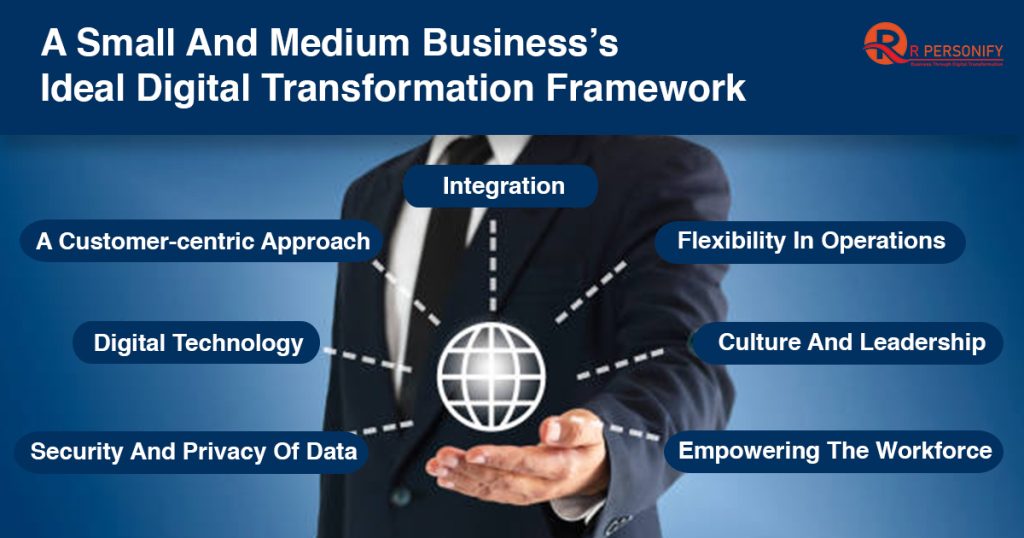
The key elements of a successful digital transformation framework are:
- Customer experience
- Operational agility
- Culture and leadership
- Workforce enablement
- Digital technology integration
- Data privacy and security
To move forward with the digital transformation process, each company must also understand the underlying stages.
6 Ways Digital Transformation Rewards Your Business with Long-Term Growth
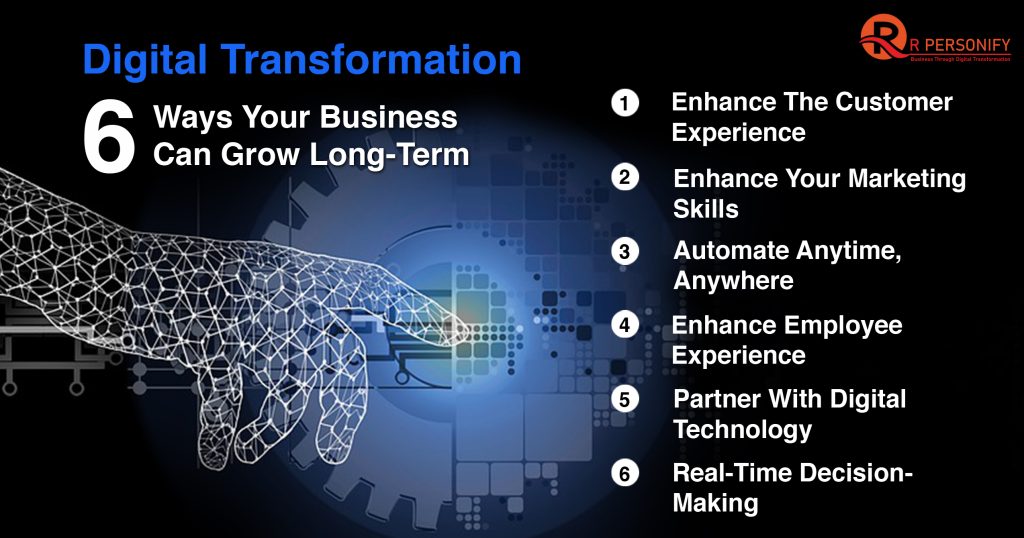
1. Enhance the Customer Experience
In order for an organization to grow over the long term, it must focus on its customer experience (CX). Successful organizations distinguish themselves by providing a better customer experience.
The digital customer experience has been enhanced by technological advancements. It is highly beneficial to business revenue to innovate and optimize the customer experience.
2. Take your Marketing Skills to the Next Level
A competitive edge can be gained through digital transformation in many areas, including marketing. Specifically, digital marketing is used in this context. However, digital transformation has a much broader impact on your marketing strategies.
In marketing, digital transformation means actively pursuing digital excellence through digital channel optimization. You should also refine your digital channels to better understand your customers’ journeys.
3. Leverage Automation Anytime, Anywhere.
The top three Digital Experience goals of technology companies worldwide are as follows:
- Automation of business processes.
- Migrate applications to the cloud.
- Utilize new-age technologies to modernize legacy systems.
With the advent of the digital age, automation has always been at the forefront of the industry. Businesses had to rethink their automation purposes after the pandemic.
In the past, the reasons were reduction of costs and improvement of performance. These days, it’s more about improving business resilience, reducing risk, and accelerating development and deployment.
Compared to earlier digital ecosystems, modern ones are increasingly complex. By integrating end-to-end automation solutions into your digital transformation, you can solve several complexities.
As a result, they can handle the challenges associated with data silos, integration, and deployment.
4. Uplift the Employee Experience
Employee experience is central to the organization’s employee lifecycle. There are several stages involved in recruitment, such as onboarding, orientation, skills development, and rewards. In order to come up with new initiatives, you will need to analyze each of them.HR departments can benefit from digital transformation as employers as it simplifies the above tasks.
5. Digitize your Business Partnerships
Today’s organizations believe that collaboration is the key to coexisting in the market. To meet the needs of customers, they work with suppliers, distributors, contractors, and consultants.
A secure channel of communication is necessary to manage business partners. With digital transformation, you can implement an eSignature system. This enables a more efficient and accurate workflow.
6. Make Better Decisions in Real-Time
A digital transformation strategy will never be complete without data and analytics. By utilizing Big Data, businesses can gain a competitive advantage.
IoT (Internet of Things) enables enterprises today to handle massive amounts of data. Analytic tools can help them convert raw data into valuable business insights. They can help businesses make informed and faster decisions.
Why is digital business transformation important for SMBs?
There are many ways for SMBs to get involved in digital initiatives. Marketing, sales, supply chains, and other concepts have already been transformed by it.
SMBs are experiencing some of the biggest changes due to digital business transformation, according to our research. They are,
- Attracting new and large clientele for the small businesses
- Keeping the competitive spirit up for medium businesses docs
- Enhance the employee productivity for every organization
In order to give you inspiration on what can be achieved, here is an example of an organization that has nailed digital transformation.
Real-Time Example:– IKEA
Any homeowner who has furnished a house knows about IKEA. Ingvar Kamprad founded the company at the age of 17 and it has gone on to become one of the most popular brands. Kamprad is not afraid to innovate and has become a global leader in the industry.

In order to engage customers and drive sales, the company has always been aggressive in its digital transformation. A customer-friendly omnichannel approach enables them to easily switch between channels.
Using Geomagical Labs, customers will be able to virtually replace existing furniture and create a 3D representation of the room. The brand plans to roll out a ‘Shop and Go’ payments system, a geolocation system for in-store products, and chatbots to streamline customer service.
What can you do to digitally transform your business going forward?
7 Tips For Your Small /Medium Business Digital Transformation
Here are those 7 best practices that can lead your small or mid-sized business towards success.
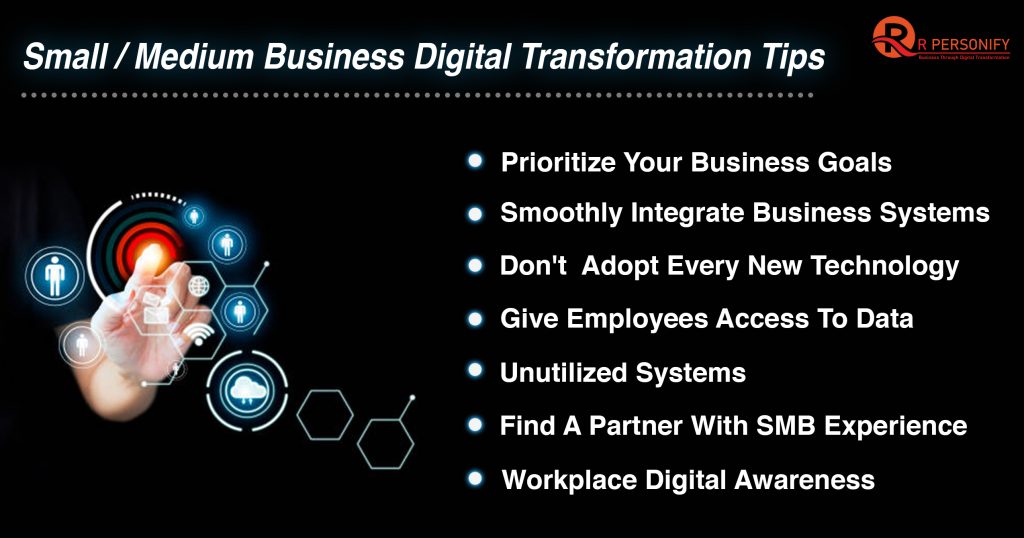
1. Establish your business goals and prioritize them
Every company, small or midsize, has its unique set of goals and objectives. Hence it is essential to identify them at the very beginning. This can be done through business process modeling. It will help you spot the gaps, identify the problems, possible risks, etc.
Also going step by step is the right way of doing it. Transforming every process, workflow, and practice will cost you unnecessary expense and unwanted chaos.
2. Integrate business systems seamlessly
Most digital business transformations are started to streamline operations, automate workflows, enhance efficiency and deliver a better customer experience.
And isn’t seamless communication the vital factor to achieve all this?
When you use automation to connect various business applications that work for the departments like finance, customer care, marketing, etc. you build an internal platform. This helps your organization to keep everything transparent, break down internal silos, and promote a customer-centric approach.
And since there is no manual data transfer there are low chances of errors and better efficiency.
3. Give employees access to data
Have you ever heard that data is the key to driving accurate business decisions? If you have then we stay, you better start believing it too! The better way to promote digital business transformation is to use the technologies that help your team to spot and extract valuable insights from multiple data sets.
This will help your employees to understand the pattern in areas like
- what customers, employees, and partners want
- will simplify the greater complex data sets
- and allow you to leverage various processing tools
This will collectively help you to make exact insights and allow everyone to real-time decision making.
4. Don’t embrace every new technology
Just like all that shines is not gold; every new technology is not worth investing in and embracing. It can get tempting to try on every other technology that promises the moon but this might just throw your budget into darker depths.
The best and most successful way to avoid this is to identify the areas of your business that will yield better results and define your needs precisely.
The thing is digital business transformation need not be complex and expensive to be successful you can use the simplest technology and still get everything you want. For instance, you can choose one predictive analysis software and get multiple benefits like generating high-quality leads, enhancing sales, and improving productivity.
5. Unutilized systems
People are often unsure how to leverage their strengths when tools and systems are implemented. Even if systems are deployed, they become inefficient without coaching.
Having excess bolt-on technologies can also delay your digital transformation journey. It is difficult for your business to run effectively if your employees are siloed, and lack knowledge of what technologies are available within the organization or the extent to which certain technologies are being used. If that is the case, it will take constant training to make sure they understand the most useful digital tools.
6. Find an SMB-experienced partner
The cost of hiring a large IT team can be overwhelming for SMBs with limited resources. However, there is a solid solution to that problem as well.
Rather than hiring an in-house team, you can opt for a company that provides digital business transformation services. Additionally, you can leverage your resources by hiring an offshore team. The other option is to hire developers for your digital transformation project in order to save time and effort.
An SMB also requires IT strategies and solutions that are different from those of a large organization. For this reason, it is a good idea to seek a partner with extensive and good experience in serving SMBs.
7. Being digitally aware at work
The goal of digital awareness is to know how basic (and not-so-basic) technology works and how to navigate it effectively. It is vital to surviving in today’s tech-dominated world and provides us with a number of opportunities for growth and development. You need to teach your employees how future technology solutions and innovations can help your company succeed.
I hope you found these practices helpful in figuring out how to transform your business digitally. Read our other blog to know more:https://rpersonify.com/how-does-digital-transformation-help-industries-in-india/
What are the Best Tools for Digital Transformation?
Digital transformation tools help businesses convert to the digital world. In addition to automating tasks, it can improve customer service. It is designed to help businesses gain a competitive edge by leveraging technology.
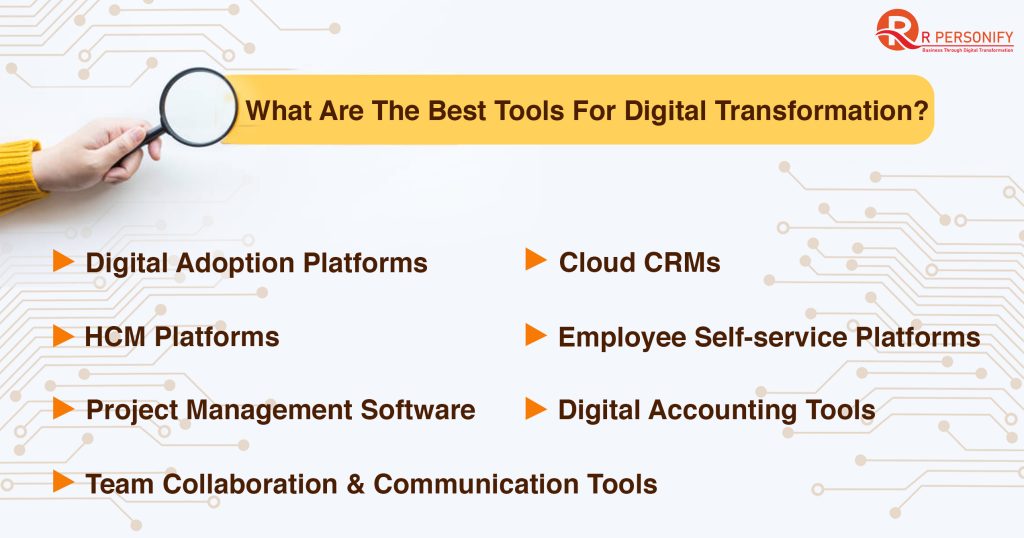
- Digital adoption platforms (DAPs)
- Team collaboration & communication tools
- Cloud CRMs
- HCM platforms
- Employee self-service platforms
- Project management software
- Digital accounting tools
Your team will be more engaged at work when you use the right tools. If you want to achieve it, here are seven tools you’ll need
1. Digital Adoption Platforms (DAPs)
Training employees on new technology is hardly ever a priority for companies. This problem can be solved by digital adoption platforms. Using a digital adoption platform, your training and digital leaders can create customized in-app guidance that guides users through the app through walkthroughs, task lists, smart tips, and tutorials.
2. Team Collaboration & Communication Tools
A collaborative tool is critical for your company, regardless of whether it is a full-time on-site operation, a hybrid operation, or a fully remote operation. Your employees should not disturb the whole team when they need to ask questions or discuss a project, regardless of whether they work in the same room. However, on-site, hybrid, and remote companies will need to approach the digitalization of internal communication differently. The use of online collaboration tools is compulsory for remote companies, but a hybrid work model requires organizations to keep everyone informed of both offline and online discussions.
3. Cloud CRMs
As part of the digital transformation process, cloud CRM solutions are inevitable. CRM platforms enable businesses to:
- Maintain a lead database and generate leads
- Create a sales funnel
- Reduce the sales cycle
- Engage customers in customer service
- Align marketing and sales efforts
- Improve customer retention, etc.
4. HCM Platforms
You need to invest in HCM software to support digital transformation in the HR department. HCM stands for Human Capital Management. Processes such as:
- workforce planning
- recruiting and hiring
- onboarding
- training
- administration
- reporting and analytics, etc.
5. Employee Self-Service Platforms
The purpose of self-service portals is to give employees access to their personal data, information, and benefit information without requiring HR assistance. These features are usually accessible through HCM platforms.
6. Project Management Software
The first thing to remember is that not everyone needs project management software. In cases where you have an advanced collaboration platform, such as Miro, investing in a separate project management solution might only complicate things.
A project management platform is essential if your teams still rely on Slack to collaborate. Using the tool, your teams will be able to assign and complete tasks, organize projects, track efficiency, and provide managers with reports.
7. Digital Accounting Tools
Businesses must take steps to digitize finance and accounting. If you haven’t already done so, it’s time to choose, implement, and most importantly, adopt a digital accounting system. These tools help you manage several integral processes on one platform, including payroll management, vendor payments, contract management, and tax filing.
Which Digital Transformation Software Will You Integrate Into Your Workflows?
In our digital transformation roadmap, we’ve outlined different types of tools you should incorporate. These essential tools would benefit businesses looking to improve their digital infrastructure. Digital transformation goes beyond utilizing digital tools. Go back over this list of digital transformation tools and decide which one you want to try first, depending on your organizational goals.
Conclusion:
Some organizations can be intimidated by digital business transformation and many small and mid-sized businesses can find the process overwhelming, but it will be the smartest decision you can make for your company. Make the most of the digital business transformation by taking an incremental approach and following the above-mentioned practices. Make sure you partner with the right partner if you want to transform your business digitally.



Recent Comments